

Custom Trophy Design: If Achievement Had a Shape, What Would It Look Like?
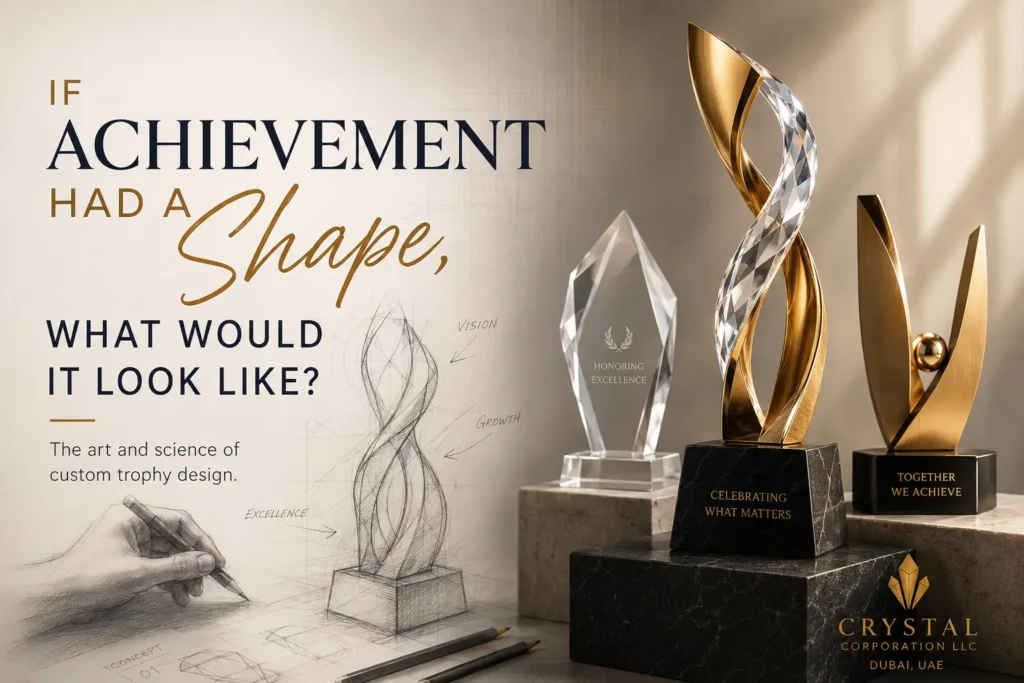
Achievement has no physical form. You cannot hold leadership. You cannot see excellence. Growth has no fixed shape. Yet when someone achieves something worth remembering, we turn that achievement into something they can hold. A trophy. So perhaps custom trophy design shouldn’t begin with a catalogue, a material or even a logo. It should begin with a question: What are we actually celebrating? How Does an Achievement Become a Trophy? Every achievement carries a different meaning. Growth could become an ascending or expanding form. Partnership could be represented by two independent elements coming together. Legacy could appear through layers, continuity or permanence. Innovation might demand something less predictable altogether. This is where custom trophy design becomes interesting. Instead of simply placing a company logo onto an existing shape, the idea itself can influence the shape. At Crystal Corporation LLC, when a client approaches us with a requirement, we first look at the event, occasion and purpose behind the award. Then comes brainstorming. Different concepts are explored, designers develop multiple directions, and the strongest ideas are selected for further development. But a beautiful design is only half the job. It also has to exist in the real world. When Imagination Meets Manufacturing Today, clients sometimes approach us with AI-generated trophy designs. Some look incredible. But there is an interesting problem: “AI doesn’t have to manufacture what it creates. We do.”This gap between visual possibility and physical manufacturability is not unique to trophy design; even advanced generative-design systems have to account for materials, manufacturing methods, performance requirements and physical constraints when developing production-ready designs. A generated design might contain floating components, extremely thin structures, impossible joints or material combinations that simply won’t behave the same way in reality. That doesn’t necessarily mean abandoning the idea. The challenge is to understand what makes the concept special and find a practical way to preserve it. That might involve changing proportions, reconsidering a connection, increasing material thickness or choosing another production technique. It is where creativity meets engineering. Why Doesn’t the First Design Always Become the Final Trophy? Because something changes when an idea becomes physical. Once a selected design moves into in-house sampling, we can see and feel things that aren’t always obvious on a screen. Is it balanced? Does the proportion feel right? How does light interact with the crystal? Do the materials work together? Does the engraving complement the form? And most importantly: Does the trophy feel the way the achievement deserves to feel? This is why a custom award may go through several stages: Idea → Design → Sample → Evaluate → Improvise → Final Crystal, acrylic, metal, wood, 3D printing, engraving and laser etching can all create different possibilities. Sometimes, combining materials provides the solution that a single material cannot. What Makes a Good Trophy? For us, a good trophy shouldn’t just be a thing. It should be a living thing. Not because it moves, but because it carries something. An emotion.A story.A moment.A meaning the recipient understands. After the ceremony ends and the applause disappears, the trophy remains. Someone may look at it years later. And ideally, they shouldn’t only remember that they won something. They should remember what they achieved. That is why custom trophy design is not simply about creating an attractive object. It is about giving an invisible achievement a physical form. So, if achievement had a shape, what would it look like? There may never be one answer. And perhaps that’s exactly why every meaningful trophy deserves to begin with the question. Quick Questions About Custom Trophy Design How are custom trophies designed? Custom trophy design usually starts by understanding the event, achievement, recipient and brand. Designers then explore concepts, shapes and materials before developing samples and refining the selected design for production. Can an AI-generated trophy design be manufactured? Not always exactly as generated. AI concepts may contain structures or material combinations that are impractical in reality. Manufacturers can often adapt the design while preserving its core creative idea. What materials can be used to create custom trophies? Custom trophies can combine crystal, acrylic, metal, wood and 3D-printed components, along with techniques such as engraving and laser etching. Why is sampling important in trophy manufacturing? A physical sample allows designers to evaluate proportion, stability, materials, finishing and overall appearance, then make improvements before final production.